
Laravel vs Node.js for SaaS Backends: Performance Comparison
Laravel vs Node.js for SaaS backend: compare performance, ecosystem, database queries, and developer speed to choose the right tech stack for your startup.
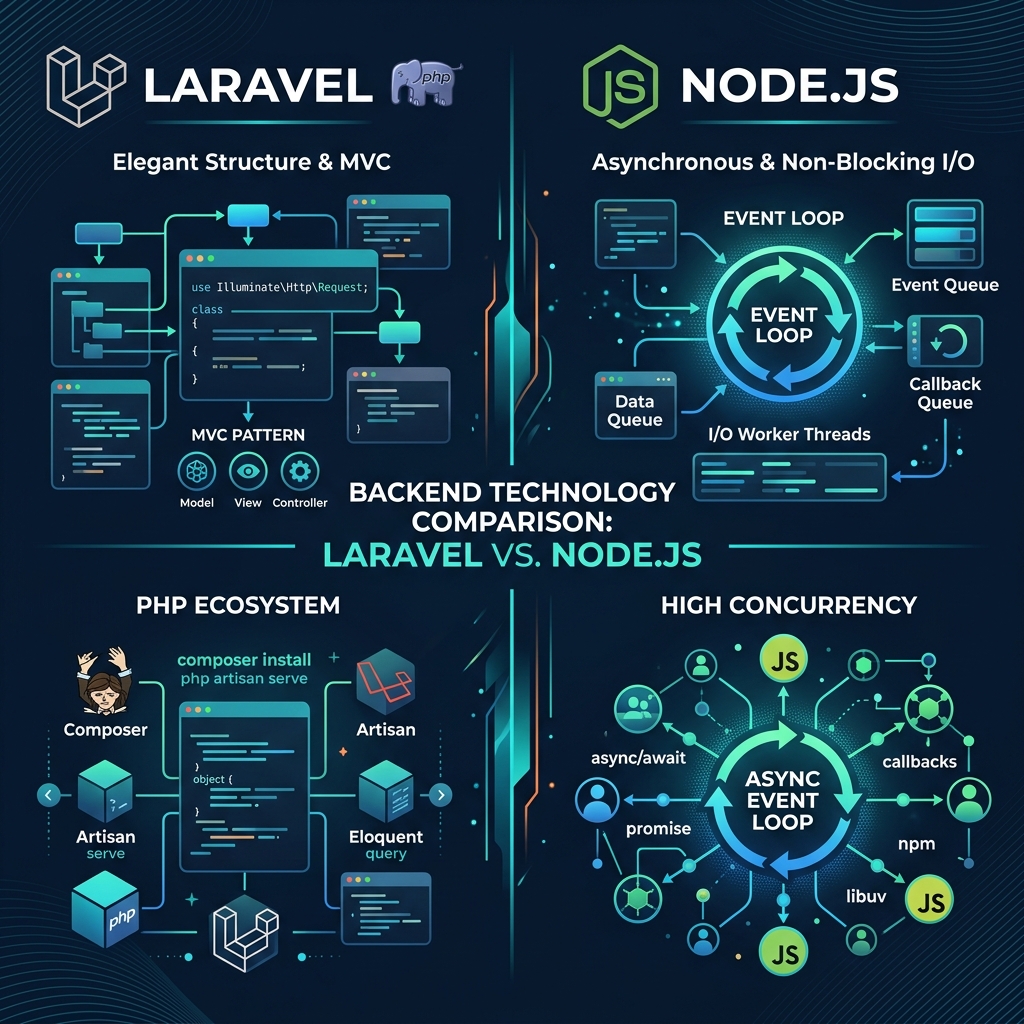
Choosing the backend stack for a new Software-as-a-Service (SaaS) platform is a high-stakes decision. The technology you select determines how fast your developers can ship features, how easily you can scale to handle active users, and how much you will pay in monthly hosting fees. For web startups, the debate often narrows down to two popular choices: Laravel vs Node.js for SaaS backend architectures. In this guide, we analyze both technologies across performance, development speed, and database operations.
1. Laravel: The MVP Acceleration Engine
Laravel, a PHP-based model-view-controller (MVC) framework, is famous for its developer-friendly syntax and comprehensive ecosystem. It includes built-in solutions for user authentication, billing integrations (via Laravel Cashier), background queues, and database migrations. This "batteries-included" approach makes it the ultimate stack for launching a stable startup MVP in under 30 days, as developers do not need to configure basic scaffolding from scratch.
2. Node.js: The Low-Latency Real-Time Specialist
Node.js (using frameworks like Express or NestJS) runs Javascript on the server, utilizing an asynchronous, event-driven, non-blocking I/O model. This architecture makes Node.js extremely efficient at handling concurrent client connections and streaming data. If your SaaS relies on real-time collaborations, WebSockets, or microservices (e.g., chat apps, streaming dashboards, collaborative canvases), Node.js delivers superior speed and low latency.
3. Side-by-Side Architectural Trade-Offs
- Development Speed: Laravel wins. Its rich ecosystem and standard conventions prevent code fragmentation and allow developer teams to collaborate easily.
- Raw Execution Speed: Node.js wins. The V8 engine executes Javascript compiled to machine code, outperforming PHP in CPU-intensive or high-concurrency operations.
- Database Interactions: Laravel's Eloquent ORM is powerful and expressive for relational databases (PostgreSQL, MySQL). Node.js works natively with relational ORMs (Prisma, TypeORM) and shines in document-store setups (MongoDB, Redis).
Build Your Scalable SaaS Platform
The right backend depends entirely on your product design. If you need a database-driven SaaS dashboard shipped quickly, Laravel is highly effective. If you need low-latency WebSocket APIs and real-time streaming, Node.js is the optimal choice. At Nexura Tech, we build enterprise-grade backends using both Laravel and Node.js. Consult with our backend engineering team today to map out your SaaS system architecture.